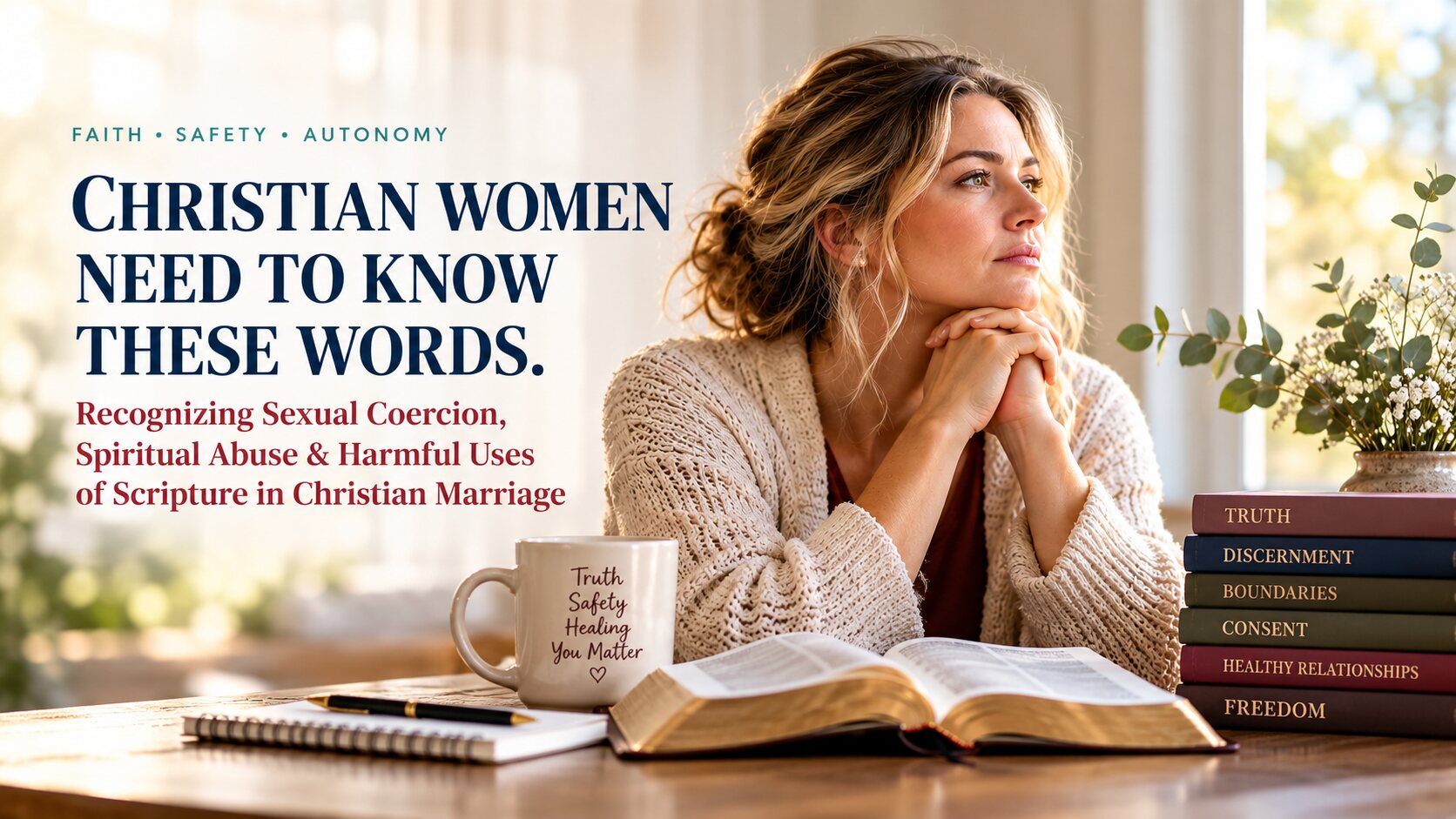
Christian woman seated beside an open Bible with the words Christian Women Need to Know These Words and themes of truth, discernment, boundaries, consent, healthy relationships, and freedom.

Faith • Safety • Autonomy

Christian Women Need to Know These Words.

Recognizing Sexual Coercion, Spiritual Abuse & Harmful Uses of Scripture in Christian Marriage

Sometimes harmful behavior is difficult to recognize because nobody ever taught us what to call it.

And sometimes something sounds “biblical” simply because a Bible verse was attached to it.

Some Christian women have received teachings about submission, headship, marital duty, sexuality, forgiveness, and obedience without receiving equally clear education about consent, coercion, spiritual abuse, boundaries, bodily autonomy, and coercive control.

This resource puts those concepts side by side.

Because you cannot critically examine a teaching you have never been allowed to name.

Content note: This resource discusses sexual coercion, intimate partner abuse, spiritual abuse, and marital sexual violence. Read at your own pace. If someone may be monitoring your device, consider your digital safety before accessing help resources.

Before we begin Five Things This Resource Keeps Separate

These five things are not automatically the same thing. Naming them separately keeps the focus where it belongs.

  1. Theological disagreement

    Christians hold different interpretations of headship, submission, gender roles, marriage, and church leadership.

  2. Harmful teaching

    A religious teaching can create harmful beliefs about sexuality, authority, silence, shame, obligation, or gender without every person who holds the broader theological tradition endorsing abuse.

  3. Coercive behavior

    Pressure, manipulation, intimidation, threats, fear, guilt, retaliation, or spiritual leverage may be used to obtain compliance.

  4. Abuse

    Patterns of coercion, intimidation, violence, exploitation, isolation, sexual abuse, or other controlling behavior can constitute abuse.

  5. Conduct with possible legal implications

    Some conduct may fall within criminal, civil, protective-order, mandatory-reporting, or other legal frameworks depending on the facts and jurisdiction.

This resource does not classify theological disagreement itself as abuse. Its focus is what happens when power, fear, pressure, manipulation, violence, sexual coercion, or religious authority are used to override another person’s agency, safety, boundaries, or consent.

A message to Christian women

A message to you

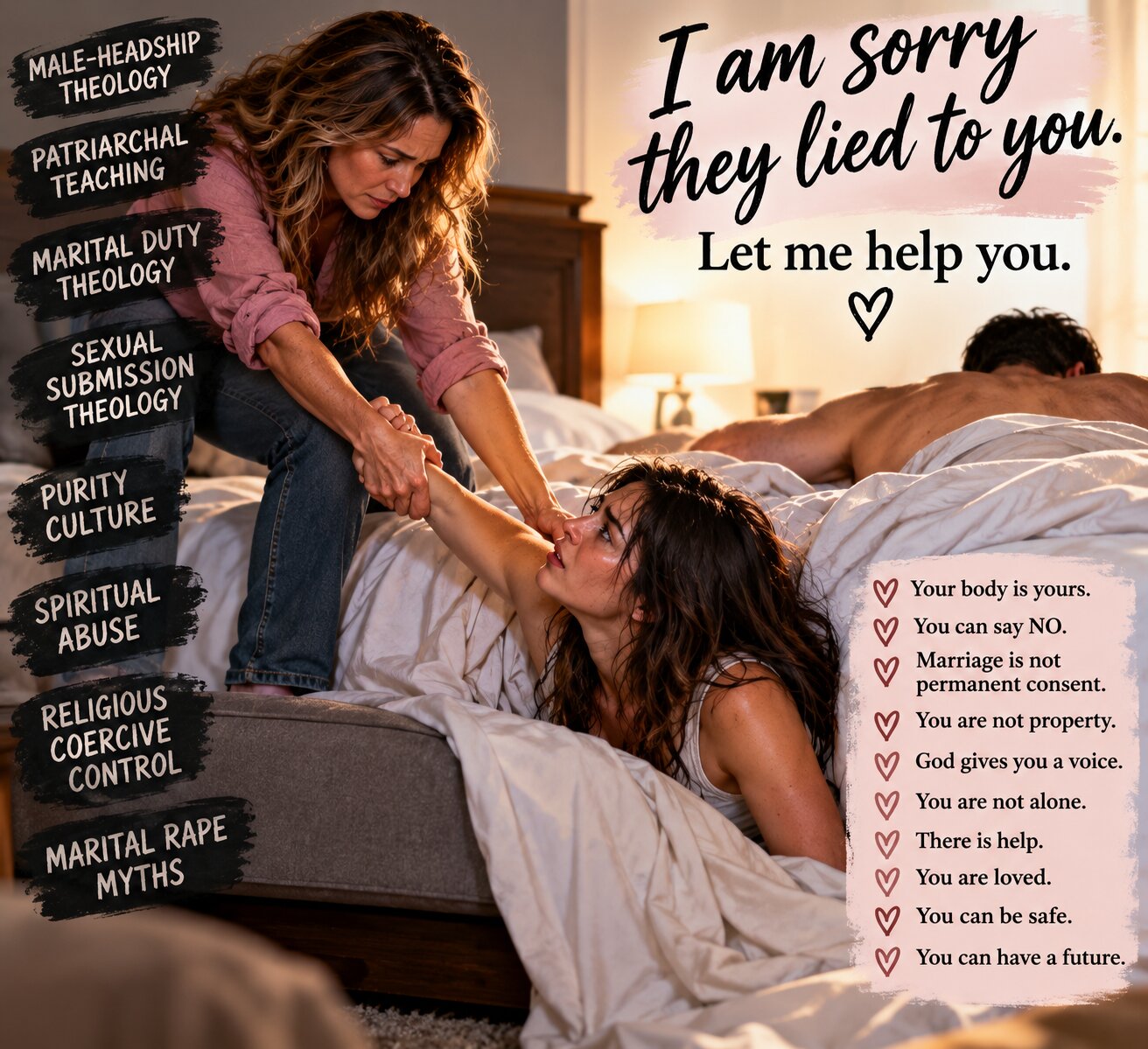
“I am sorry they lied to you.
Let me help you.”

If you were taught that becoming a wife meant surrendering ownership of your body, that saying no to your husband was rebellion against God, or that enduring unwanted sexual activity was part of biblical submission, you deserve the opportunity to examine those teachings carefully—for yourself, in context, and against the whole of Scripture.

  • Your body is yours.
  • You can say NO.
  • You can say STOP.
  • Marriage is not permanent consent.
  • You are not property.
  • Your voice matters.
  • You can ask for help.

Vocabulary Know the Words

Each term below is labeled by category, so beliefs, teachings, behaviors, and myths are not confused with one another.

Term 01Category: Theological belief

Male-Headship / Patriarchal Theology

Male-headship theology generally teaches that God has assigned husbands a particular leadership or “headship” role within marriage.

Christians disagree about exactly what biblical headship means. Not everyone who holds complementarian or male-headship beliefs believes husbands possess unlimited authority, sexual authority, or that wives should tolerate abuse.

The danger: when headship becomes entitlement or compulsory obedience

  • “He is your husband. You need to obey him.”
  • “A submissive wife doesn’t tell her husband no.”

Marriage does not turn spiritual leadership into sexual authority over another person’s body.

A theological belief about marital roles does not erase a spouse’s agency, safety, boundaries, or consent.

Term 02Category: Teaching

Marital Duty / Marital Debt Theology

This teaching can frame sexual access as something one spouse owes another because they are married. 1 Corinthians 7:3–5 is sometimes used in these discussions.

Scripture · read the whole verse

“The wife does not have authority over her own body, but the husband does. Likewise the husband does not have authority over his own body, but the wife does.”

— 1 Corinthians 7:4, ESV

Notice the second half

“Likewise the husband does not have authority over his own body, but the wife does.”

Paul’s statement is mutual. He did not establish:

Not established: Husband = OwnerNot established: Wife = Property

Marriage is a covenant, not ownership.

Interpretation: Whatever one’s theology of marital intimacy, Scripture should not be reduced to a weapon for demanding sexual compliance.

Term 03Category: Teaching

Sexual Submission Theology

The idea that being a submissive Christian wife requires meeting her husband’s sexual desires even when she does not want sexual activity. In this teaching, a wife may be told she is obligated to meet her husband’s sexual desires even when she does not want sexual activity.

A belief some women carry

  • “If I say no to my husband, I’m saying no to God.”

For someone whose relationship with God is central to her identity, this belief can become extraordinarily powerful. Refusing unwanted sex stops feeling like a personal boundary and starts feeling like disobedience to God—so fear of spiritual failure can silence her own “no” before she ever says it.

Sex obtained through fear, intimidation, persistent pressure, threats, shame, manipulation, retaliation, or spiritual condemnation is not healthy mutual intimacy.

Term 04Category: Theological framework

Biblical Patriarchy

Biblical patriarchy is a broader theological framework that may place men in authority within the family, church, or both.

Not everyone who believes husbands and wives have different roles believes women should tolerate abuse.

The danger: a progression like this

  • Men lead.
  • Women obey.
  • Women stay quiet.
  • Men make the final decisions.
  • A wife’s resistance is rebellion.
  • Questioning male authority is questioning God.

Environments that discourage questioning, disclosure, boundaries, outside help, or accountability can make abuse more difficult to identify and report.

Term 05Category: Cultural teaching

Purity Culture

Some purity-culture environments heavily emphasize girls’ and women’s responsibility for sexual boundaries. The messages can then reverse after the wedding.

Before marriage

  • Don’t have sex.
  • Don’t tempt men.
  • Cover your body.
  • Protect your purity.
  • Don’t cause men to stumble.

After marriage

  • Don’t deny your husband.

A woman’s body can move in the messaging from something she believes she must constantly guard to something she believes she must constantly provide.

Neither sexual shame nor sexual obligation provides a sufficient foundation for healthy intimacy.

Healthy intimacy requires communication, mutuality, agency, respect, safety, and consent.

Term 06Category: Coercive behavior

Sexual Coercion

Sexual coercion is pressure, manipulation, intimidation, threats, fear, guilt, shame, persistent pressure, relationship leverage, or other forms of control used to obtain sexual activity.

Examples may include

  • “If you loved me, you would.”
  • “You’re my wife.”
  • “God says you’re supposed to submit.”
  • “The Bible says your body belongs to me.”
  • “You’re making me sin.”
  • “A good wife would do this.”
  • “I’ll find someone else who will.”
  • “You’re destroying our marriage.”

Coercion does not always involve physical force.

Sometimes it involves wearing someone down until resistance feels pointless.

Sometimes someone eventually says “fine” because saying no appears likely to result in anger, punishment, humiliation, abandonment, spiritual condemnation, or retaliation.

Marriage does not erase consent.
  • A woman can say NO.
  • A wife can say STOP.
  • A person can change their mind.
  • Consent to one activity is not consent to every activity.
  • Past consent does not guarantee present consent.
  • “I do” is not permanent consent to every future sexual act.
Term 07Category: Coercive behavior

Religious Coercive Control

Religious coercive control occurs when religious beliefs, spiritual authority, Scripture, or fear of divine consequences are used as mechanisms of control.

Examples

  • “God commands you to submit.”
  • “You’re disobeying God.”
  • “A godly wife satisfies her husband.”
  • “You’re causing him to sin.”
  • “God hates divorce.”
  • “You need to forgive him.”
  • “Don’t expose your husband.”
  • “You need to take this to God instead of telling people.”
  • “You’re supposed to suffer like Christ.”

For someone whose faith is central to her identity, fear of disappointing God can become extraordinarily powerful leverage.

Using someone’s faith to override sexual boundaries, safety, agency, or consent is a misuse of spiritual authority.

Term 08Category: Abuse

Spiritual Abuse

Spiritual abuse is the use of religious beliefs, Scripture, church authority, spiritual status, or religious community to control, frighten, manipulate, shame, exploit, silence, or rationalize harm toward another person.

It can occur

  • within intimate relationships
  • within families
  • within churches
  • within pastoral relationships
  • within counseling or ministry environments
A Bible verse does not transform coercion into holiness.
Term 09Category: Myths

Marital Rape Myths

These are common myths. Each one is false as a description of consent.

  • Myth: “A husband can’t rape his wife.”
  • Myth: “She already consented when she married him.”
  • Myth: “Sex is his right because they’re married.”
  • Myth: “A Christian wife shouldn’t refuse her husband.”
  • Myth: “If she eventually stopped resisting, it wasn’t assault.”
  • Myth: “If there wasn’t physical violence, she consented.”
  • Myth: “If they’re still married, it couldn’t have been abuse.”

Marriage does not transform another person’s body into property.

A wedding ring is not permanent sexual consent.

Self-reflection When Scripture Becomes a Weapon

There is a difference between studying Scripture together and using Scripture to obtain compliance.

  • What happens when you say NO?
  • Can you disagree without being threatened spiritually?
  • Can you establish a boundary without being accused of rebellion?
  • Can you ask questions about the interpretation being presented to you?
  • Can you speak privately with people outside the marriage?
  • Can you tell someone what happens at home?
  • Can you seek counseling or professional help independently?
  • Can you leave the room?
  • Can you stop sexual activity after it begins?
  • Can you say, “I don’t want this,” without fearing punishment afterward?

These questions do not diagnose a relationship by themselves. They can help reveal patterns involving power, fear, coercion, retaliation, and freedom of choice.

Scripture Now Look at Jesus.

Christians examining how power is used in marriage and in the church can consider how Jesus interacted with women. The passages below are identified so you can read each one in full, in context, for yourself.

John 4

Jesus publicly spoke with the Samaritan woman despite significant social boundaries surrounding the encounter.

John 8:1–11

Jesus intervened in the public condemnation of a woman and challenged those surrounding her.

Mark 5:25–34

A woman suffering from bleeding touched Jesus. Rather than treating her as shameful, Jesus addressed her as “Daughter.”

Luke 10:38–42

Mary sat at Jesus’ feet learning. When Martha objected, Jesus defended Mary’s choice.

Interpretation: Across these accounts, Jesus treats women as persons with dignity, agency, and a place among His followers—not as objects to be controlled.

  • Women followed Jesus.Luke 8:1–3
  • Women supported His ministry.Luke 8:3
  • Women remained near the cross.Mark 15:40–41; John 19:25
  • Women went to the tomb.Luke 24:1–10
  • Women were among the first witnesses of the resurrection.Matthew 28:1–10; John 20:11–18

Jesus did not teach:

“Women exist for your sexual use.”

Scripture

“Whoever wants to become great among you must be your servant.”

— Matthew 20:26, NIV

Interpretation: Christian leadership is supposed to resemble service, not entitlement.

What about Ephesians 5? What About “Wives, Submit to Your Husbands”?

Ephesians 5 is frequently central to Christian discussions about marriage and submission, and it should be read in context. Read Ephesians 5:21–33 as a whole.

The verse just before

“Submit to one another out of reverence for Christ.”

— Ephesians 5:21, NIV
Then

“Husbands, love your wives, just as Christ loved the church and gave himself up for her.”

— Ephesians 5:25, NIV

Christ’s example is self-giving love.

  • Not sexual entitlement.
  • Not domination.
  • Not intimidation.
  • Not coercion.
  • Not fear.

Interpretation: Different Christian traditions interpret marital roles differently. But theological disagreement about marital roles should never be used to obscure coercion, violence, exploitation, or sexual activity without consent.

  • Context matters.
  • Mutuality matters.
  • The whole passage matters.

Patterns to notice Warning Signs

Pay attention when religious teaching is repeatedly used to tell a woman:

  • Her husband’s desires matter more than her boundaries.
  • Saying no to sex is sinful.
  • Her husband’s sexual behavior is her responsibility.
  • She caused his pornography use, infidelity, anger, or misconduct.
  • Submission means she cannot disagree.
  • She needs permission to seek help.
  • Protecting herself is rebellion.
  • Telling someone about abuse is gossip.
  • Reporting harmful behavior dishonors her husband.
  • Forgiveness requires immediate reconciliation.
  • Separation automatically means she failed God.
  • Protecting the church or family’s reputation is more important than disclosure.
  • Male authority should not be questioned.
  • Establishing boundaries makes her selfish, rebellious, bitter, unforgiving, or ungodly.

One statement alone does not tell the whole story. Patterns matter.

Especially patterns involving fear, isolation, intimidation, sexual pressure, surveillance, threats, financial control, spiritual condemnation, or retaliation for establishing boundaries.

What healthy looks like What Healthy Intimacy Looks Like

  • Mutuality
  • Safety
  • Communication
  • Respect
  • Freedom to say yes
  • Freedom to say no
  • Freedom to stop
  • Freedom to change your mind
  • Respect for boundaries
  • Concern for each other’s physical and emotional wellbeing

A “yes” means very little when someone does not believe they are allowed to say “no.”

For you Christian Women, Hear This Clearly

You did not stop being a person when you became a wife.

  • You still have a voice.
  • You still have boundaries.
  • You can say NO.
  • You can say STOP.
  • You can change your mind.
  • You can ask questions.
  • You can tell someone what happened.
  • You can seek counseling outside your church.
  • You can speak with an advocate.
  • You can seek medical care.
  • You can contact appropriate authorities when needed.
  • You can make a safety plan.
  • You can leave a dangerous situation.
  • You can protect your children.

Protecting yourself from abuse does not mean that you failed God.

Institutional practice What Churches Should Understand

Churches should strive to be among the safest places for someone to disclose abuse.

Listen

Listen without immediately defending the person accused.

Understand

Learn about trauma, coercive control, sexual violence, spiritual abuse, grooming, and barriers to disclosure.

Refer

Know when concerns require trained advocates, clinicians, medical professionals, law enforcement, child protection, or other appropriate authorities.

Prioritize safety

Do not make reconciliation more important than immediate safety.

Accountability

Do not use forgiveness to bypass accountability.

Protect people

Institutional reputation should never take priority over safeguarding people.

  • Silence is not always submission.
  • Endurance is not always faithfulness.
  • Forgiveness is not permission.
  • Forgiveness and reconciliation are not the same thing.
  • Marriage is not ownership.
  • Sexual compliance is not proof of godliness.

For the next generation Teach Our Daughters — and Our Sons

Marriage is a covenant of love.

It is not a transfer of ownership.

  • Your spouse is not your property.
  • Their body is not yours to command.
  • Their boundaries do not disappear because they married you.
  • Their faith should never become leverage against them.
  • Their fear of disappointing God should never become a weapon used to obtain compliance.
  • Scripture should never be twisted into permission to sexually control another human being.

In closing Know the words

  • Know the words.
  • Know the warning signs.
  • Know the Scripture.
  • Know your boundaries.
  • Know that you can ask for help.
  • Know that your voice matters.

When we have language for coercion, manipulation, spiritual abuse, and sexual entitlement, it becomes much harder for someone to convince us that those things are holiness.

If someone taught you that being a Christian woman means surrendering your right to say no:

I am sorry they taught you that.

  • You deserve to know the difference between love and control.
  • You deserve to know the difference between biblical intimacy and sexual entitlement.
  • You deserve to know the difference between faith and fear.

And you deserve a Christian community willing to help you tell the difference.

Get help & safety Need Help?

If you are in immediate danger, call 911 or your local emergency number when it is safe to do so.

Digital safety: If you believe someone monitors your phone, computer, browser history, accounts, or location, consider using a safer device before researching abuse, making plans, or contacting support. The NNEDV Safety Net Project at techsafety.org (external site, opens in a new tab) offers technology-safety information for survivors.

Sources Evidence, Support & Further Reading

These links go to the official websites of each organization and open in a new tab.

Oklahoma Child Wellbeing

Spiritual Abuse: Recognize the Signs. Protect Your Safety. Reclaim Your Voice.

Our survivor-centered guide to spiritual abuse, spiritual coercion, safety planning, and safer accountability in faith communities.

Download the Spiritual Abuse Guide (PDF) (opens in a new tab) PDF · Oklahoma Child Wellbeing

About the Scripture on this page: Bible passages are identified by book, chapter, and verse so readers can study them in full and in context. Direct quotations name their translation (ESV or NIV). Explanatory notes marked “Interpretation” reflect a survivor-safety reading of these passages; Christian traditions interpret them in different ways, and no single denominational view is presented here as universal Christian doctrine.

About This Resource

This resource is provided for education, prevention, advocacy, and survivor support. It is not individualized legal, medical, mental health, pastoral, or emergency advice.

Christian traditions differ in their interpretation of marriage, headship, submission, and gender roles. This resource does not treat theological disagreement itself as abuse.

Its focus is the use of power, pressure, fear, manipulation, violence, sexual coercion, or religious authority to override another person’s safety, agency, boundaries, or consent.

Oklahoma Child Wellbeing is not law enforcement, child protective services, a crisis line, or a substitute for professional advice.

Back to Resources & Training